
Sister Katherine Maria, MICM
True Devotion to Mary:The Necessity of Devotion to the Blessed Virgin Mary
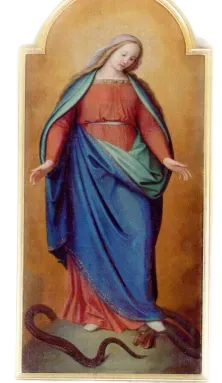
Saint Louis prophesied, after enumerating appropriate qualities defining the need for Mary, “Lastly, Mary must be terrible to the devil and his crew, as an army ranged in battle, principally in these latter times, because the devil, knowing that he has but little time, and now less than ever, to destroy souls, will every day redouble his efforts and his combats. He will presently raise up cruel persecutions, and will put terrible snares before the faithful servants and true children of Mary, whom it gives him more trouble to conquer than it does to conquer others…. It is principally of these last and cruel persecutions of the devil, which shall go on increasing daily till the reign of the Antichrist, that we ought to understand the first celebrated prediction and curse of God, pronounced in the terrestrial paradise against the serpent. It is to our purpose to explain this here, for the glory of the most holy Virgin, for the salvation of her children and for the confusion of the devil: I will put enmities between thee and the woman and thy seed and her seed; she shall crush thy head, and thou shalt lie in wait for her heel. (Gen. 3:15)
“What Lucifer has lost by pride, Mary has gained by humility."
“What Lucifer has lost by pride, Mary has gained by humility…. God not only set an enmity, but enmities not simply between Mary and the devil, but between the race of the holy Virgin and the race of the devil; that is to say, God has set enmities, antipathies and secret hatred between the true children and servants of Mary and the children and slaves of the devil.”
Continuing, he describes the challenges and consolations of those who will follow this devotion: “But the power of Mary over all the devils will especially shine forth in the latter times, when Satan will lay his snares against her heel: that is to say, her humble slaves and her poor children, whom she will raise up to make war against him. They shall be little and poor in the world’s esteem, and abased before all, like the heel, trodden underfoot and persecuted as the heel is by the other members of the body; but in return for this they shall be rich in the grace of God, which Mary shall distribute to them abundantly.
They shall be great and exalted before God in pure truth, according to the holy Gospel, and not according to the maxims of the world; troubling themselves about nothing; not accepting persons; sparing, fearing and listening to no mortal, however influential he may be….”
Fundamental Truths of Devotion to the Blessed Virgin
“If, then,” Saint Louis writes, “we establish solid devotion to our Blessed Lady, it is only to establish more perfectly devotion to Jesus Christ, and to provide an easy and secure means for finding Jesus Christ. If devotion to Our Lady removed us from Jesus Christ, we should have to reject it as an illusion of the devil; but so far from this being the case, devotion to our Lady is, on the contrary, necessary for us… as a means of finding Jesus Christ perfectly, of loving Him tenderly and of serving Him faithfully.”
If there was nothing else to take away our fear of excess in the praises of Mary, Saint Augustine declares that whatever we may say in praise of Mary is little in comparison with that which she deserves on account of her dignity as the Mother of God. Saint Louis shows that the goal of devotion to Mary is devotion to Jesus Christ. She is the eternally appointed road to Christ. Saint Alphonsus Liguori writes in his book, “Glories of Mary,” “No one denies that Jesus Christ is our only mediator of justice, and that He by His merits has obtained our reconciliation with God. But, on the other hand, it is impious to assert that God is not pleased to grant graces at the intercession of his saints and more especially of Mary his Mother, whom Jesus desires so much to see loved and honored by all. Who can pretend that the honor bestowed on a mother does not redound to the honor of the son?” Saint Bernard also affirms this when he says, “Let us not imagine that we obscure the glory of the Son by the great praises we lavish on the mother; for the more she is honored, the greater is the glory of her Son. There can be no doubt that whatever we say in praise of the Mother is equally in praise of the Son.”
"If, then, we establish solid devotion to our Blessed Lady, it is only to establish more perfectly devotion to Jesus Christ"
Saint Louis de Montfort
Slaves of Mary
At this point Montfort suddenly introduces in his thesis a word that radicalizes his spirituality—Slavery! Although the term sounds harsh at first, as he explains it, he reveals a beautiful concept bolstered by historical evidence that it is not new. He brings this spiritual servitude to another level and application, where the total commitment instead of binding the liberty of a soul, frees it. “To serve thee, O Mary, is Liberty!” In his book, Marian Devotions, Rev. Dr. Ildefonso R. Villar explains, “I must have an intimate knowledge of the strict meaning of this word—slavery. A slave depends on somebody else in such a manner that all that he is and has does not belong to him but to his master. (Such was the barbaric law of old.) He disposes of nothing and of nobody, not even himself. He has no freedom; he must do only what his master wishes. The master can do whatever he does with his slave. The slave is merely at his mercy.
Now this slavery of man to man as it existed in pagan times, is brutal and unworthy, degrading, forbidden by God. It was abolished by Christ. If this slavery is practiced towards God, however, and if a man freely and voluntarily renders himself a slave to Him, this slavery is the greatest, the most worthy and beautiful possible. It is a proof of a most profound humility based on the formula, “all belongs to God, nothing is mine. Consequently everything for God and nothing for myself.” So then my body with its senses, my soul with its powers and all the actions and movements of my being, all my sensations, thoughts, affections, loves, all my words, as well as my silences, my laughter, whatever I suffer, whatever I do, whenever I walk, sleep, eat, or pray, all is for God. This most sublime slavery is the highest possible sanctity. The more independently of God I live and work, the greater my faults and my imperfections; whereas the more God dwells and works within me, the greater will my perfection be. Is this not slavery? Well, thus my own slavery to Mary ought to be. I must live as her son. I must depend on her for everything. My intentions must always be hers. The means I use must be hers. I must hide in her heart in order to live in her presence so that, by living in this manner, I shall finally direct all my activities, not to my own glory or profit, but only to her glory and to her service.”