
Monsignor DeSegur
Our Lady of VICTORIES
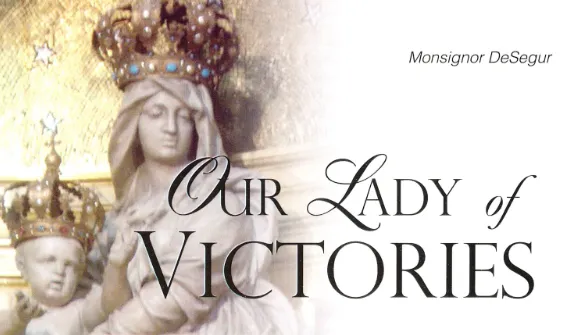
Our Lady of Victories is the name given to a church in Paris situated or rather hidden in one of the most commercial, most stirring, and least Christian quarters of that great city. This church, of very humble exterior, was even unknown to the Parisians themselves before the year 1836. It was certainly a parish church, but one without earnest priests not one man in the congregation fulfilled his Easter duties no one ever came to High Mass; and not more than fifteen or twenty women, out of seventeen thousand inhabitants, approached the Sacraments!
Today this little church is known throughout the world. Its very name causes Catholic hearts to beat not only in France, but throughout Europe, in America, in Africa, and in those far-off islands where our missionaries carry the Faith. Our Lady of Victories is a great religious center for all pious souls in Paris and in the provinces. Its nave is always full of fervent worshippers, and the church is so crowded that it is necessary to come a long time before the service in order to find a place.
What could have happened to effect so complete a change in such a few years? Listen, for the finger of God is there. The good curé of our Lady of Victories, M. Desgenette, a man of eighty years of age, had had the charge of this unhappy parish during four years. Seeing that all his care, had been utterly useless, and in his humility attributing this want of success to his own unworthiness, he had been thinking for some time of resigning his mission into the hands of the Archbishop of Paris. One day, in the month of December, he commenced the Mass under the impression of this thought. An unusual disquietude oppressed his soul, so much so that on reading the Sanctus he was obliged to stop to arouse himself effectually from his preoccupation and to collect his thoughts. While he was thus seeking to gain peace within, no one being near him, a clear distinct voice suddenly spoke these words: “Consecrate thy church and parish to the most Holy and Immaculate Heart of Mary!” The poor priest, utterly bewildered, took the voice for a delusion of his troubled senses. “I am not only an unworthy curé,” he said to himself, groaning in spirit, ‘but now I am losing my senses and am going mad. I must hesitate no longer, but must give up my mission without more delay.” Reassured by this determination, he ended holy Mass with calmness.
His thanksgiving was longer than usual. His trouble and preoccupation returned to him anew, and he strengthened himself in his determination to resign a charge of which he believed himself so evidently unworthy. He was kneeling alone in the choir. He was about to rise to return home and write at once to the Archbishop, when the same voice echoed in his ears once more, saying to him in accents of majesty and command: “Consecrate thy church and parish to the most Holy and Immaculate Heart of Mary!”
The same voice echoed... once more, saying to him in accents of majesty and command: "Consecrate thy church and parish to the Most Holy and Immaculate Heart of Mary!"
The holy priest, moved to the depths of his soul, could no longer doubt the reality of what had happened to him. He prostrated and humiliated himself, asked help from God, and invoked, in order to know what he must do, the most Holy and Immaculate Heart of Mary, to which he had never had recourse until then, and of which he had spoken, as he afterwards acknowledged with simplicity, as a singular devotion, impracticable and useless. After all, he said to himself, I may as well try.
He did indeed try. Returning home, he wrote with a facility he had never before experienced, the rules of a confraternity of Our Lady of Victories, in honor of the Most Holy and Immaculate Heart of Mary. Astonished at the strange rapidity with which he had been able to accomplish this work, he carried it to Monsignor de Guelen, the Archbishop of Paris, of holy and revered memory. He read the statues, and not only authorized the curé to establish his new confraternity, but also insisted upon his doing so in the most imperative manner. “You will commence next Sunday,” he added. It was then Friday.
On the Sunday, the good curé ascended the pulpit at the time of the sermon, and looking down upon his deserted church, announced to the few women who composed his listeners, that that very evening the meetings and religious services of the Confraternity of the Immaculate Heart of Mary would commence in that church.
Coming down from the pulpit, he was stopped by a man whom he had not seen when he went up, and who asked him when he could receive his confession? He was a rich merchant of the parish, with whom the curé was acquainted, but who never came to church. The good priest could but regard this unexpected conversion as a sign from God to give him confidence and to prove to him that his work came to him from heaven.
That evening when the curé full of apprehension, entered his poor church, he was stupefied at seeing it filled with men, women, and young people in greater numbers than at any previous solemnity. He gave an instruction which was followed by the singing of the Litany of the Blessed Virgin. When they reached the invocation so dear to our hearts, Refugium peccatorum ora pro nobis! (Refuge of sinners, pray for us), an involuntary and supernatural emotion took possession of the whole assembly, who unanimously repeated three times over as one great cry of confidence and repentance, Refugium peccatorum, ora pro nobis. The curé, himself overcome by heartfelt emotion, admired the goodness of God, Who thus changes the hearts and attracts the souls of men.
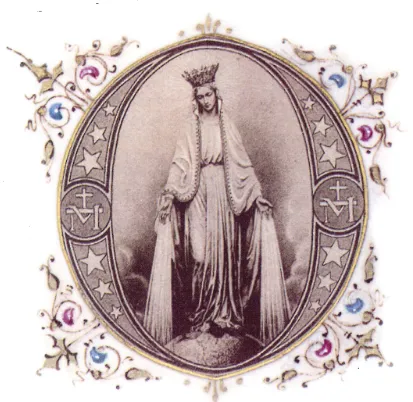
The Blessed Virgin, the Refuge of sinners and the Mother of Mercy, had made choice of a new sanctuary upon earth from which to shed over France and the whole world the graces of her Divine Son. The Confraternity, later an arch-confraternity, of Our Lady of Victories was founded, and from that day, not a month, nor a week has passed without wonders of every description, sudden conversions of hardened sinners, evidently miraculous cures, and graces of all kinds being sent to prove to the world that the arm of God is not shortened, and that the Blessed Virgin is always our Mother.
More than three million of the faithful, with our Holy Father Blessed Pope Pius IX, at their head, are inscribed in the ranks of this admirable arch-confraternity, and wear upon their breast, as a sign of gratitude and love, the medal named the Miraculous Medal, on account of the signal graces of which it has been the instrument…
In France, where this devotion first took root, much love and reverence are paid to the medal and sanctuary of Our Lady of Victories, but what can be said for England, the country which stands so much in need of grace, yet has no faith in Mary’s prayers, no love for her who is so dear to the Sacred Heart of Jesus?
In a time of darkness and temptation, England lost the gift which God Himself had given nearly a thousand years earlier. The gift is the most precious He can bestow upon His redeemed children, the light of the One True Faith. Then, for the first time, the people, bewildered and deceived by all manner of strange and contradictory doctrines turned away from Mary, and would no longer acknowledge the Mother of God to be their Mother and their Queen. Then they learned to hate what they had loved, to despise what they had honored, and to traduce the teaching they had reverenced and believed.