
James A. Magner
Cause of Joy
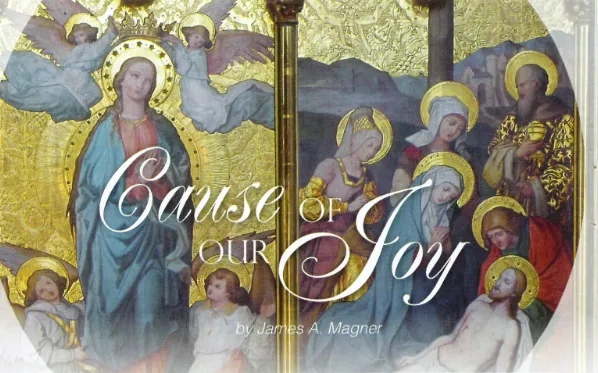
In art, literature, and devotion of the Blessed Virgin Mary, it is often difficult to say which theme is dominant and more characteristic, that of joy or of sorrow. Devotion to the Sorrowful Mother, recalled in the Seven Dolors and in the prophecy of Simeon-Thy own soul a sword shall pierce, that out of many hearts thoughts may be revealed. (Luke 2: 35)-plays a leading part in the prayers of Christians to the Blessed Mother. This is only logical, as recollection of the passion and death of her Divine Son comes uppermost in typifying His infinite love and act of Redemption. The poverty and obscurity of the Saviour’s birth in a manger, the circumstances leading to the slaughter of the Innocents by Herod and the flight of the Holy Family into Egypt, the conspiracy of Christ’s enemies, and the bloody culmination of His earthly career on Calvary, all come to mind in tracing the career of Mary. This chain of events, which would spell frustration and sorrow in any normal life, was certainly not made less poignant in her sorrowing heart by the fact that she knew her Son was the Son of God, teaching the eternal truth and doing penance for the sins of men.
The Blessed Virgin, nevertheless, emerges from these sorrows, not a grieving or disconsolate figure, like Rachel, but rather as one who has known how to bear and conquer sorrow. There is no suggestion of moroseness or frustration in her character. On the contrary, in each case of adversity, the Holy Scriptures refer to her as turning sorrow into joy and of meeting harsh reality with optimistic determination.
The observation is of special significance for a philosophy of Christian living and in the formation of the Catholic mind. Since Mary was the Mother of Christ, she may also be regarded as the first Christian and indeed as the exemplar of all Christians. It is only logical that her view of life and her reactions, in the presence of joy or sorrow, should be indicative of basic attitudes in all who cultivate her devotion and strive for the Christian way of life.
The Blessed Virgin While the Gospels do emerges from these sorrows, not a grieving or disconsolate figure... but rather as one who has known how to bear and conquer sorrow
Despite her unique character, because of the divine personality of her Son, the general movement of events particularly in their domestic setting, does not differ substantially from that in the of the average person. The childhood of Christ and her life with Saint Joseph do not offer any evidence of other than a quiet, joyful home life. Her interest in social life and her solicitude that all should go smoothly are exemplified in the wedding feast of Cana when she suggested that her Divine Son perform a miracle to replenish the wine. While the Gospels do not mention the time or the circumstances of the death of Saint Joseph, we must surmise that it did not leave her prostrated with rebellious grief or unable to carry on her tasks. When at Lourdes, Fatima, Guadalupe, and La Salette, have, it is true, been associated with elements of keen suffering and anguish for the participants. Her appearance, however, has always been described as that of an exceedingly beautiful woman, clothed in glory. Her messages have always been positive, of hope and the way to happiness even on earth.
It is supremely important that this aspect of Mary’s personality and message be stressed in Catholic education and devotion. Otherwise, only a partial and possibly distorted view of the Christ way of life may result. The Blessed Virgin emerges from these sorrows, not a grieving or disconsolate figure… but rather as one who has known how to bear and conquer sorrow Christ began his public mission, she entered into His work with enthusiasm and fidelity. She served as a bearer of strength and counsel to the Apostles, even after the death and resurrection of Christ. This is not the story of a pessimistic or inherently sorrowful woman.
It is interesting to note also that, whereas the Sorrowful Mysteries of the Rosary are devoted to the death and passion of Christ, the Joyful Mysteries are those devoted to His Blessed Mother: the Annunciation, the Visitation of her cousin Elizabeth, and the Finding of the Boy Christ in the Temple.
The apparitions of the Blessed Virgin at various times and places, as True Devotion to Mary The prayer “to thee do we cry, poor banished children of Eve; to the thee do we send up our sighs, mourning and weeping in this valley of tears may otherwise leave an altogether false impression of God’s beautiful creation and the joy He intends we should take in orderly living. The life of the Blessed Virgin demonstrates that sorrow, pain, and disappointment are external and can exist with true peace of soul and happiness.
Devotion to the Blessed Virgin under the title “Our Lady of Sorrows” pays honor to the sufferings which she shared with her Son, and it appeals for her consolation and encouragement to bear our burdens in dark hours. It is not and must not become, however, confused with melancholy or moroseness of spirit. Christianity is essentially a religion of joy, the joy of the heart living in the presence of God. It is by understanding this as the normal way of life, that we understand how the Virgin, even as Our Lady of Sorrows, is the cause of our joy.
there is no one so earthly or engrossed in the tasks of his trade who cannot lift his heart to God and sanctify himself through cheerful activity and joyous living.
Needless to say, this view of the world and of the challenge of living on this terrestrial sphere creates a definite pattern of activity based on the recognition of certain values. For one thing, it points logically to the determined cultivation of a cheerful imagination and a realistic optimism; it also brings the virtue of charity down to earth in workable forms, through the development of the arts of good manners, courtesy, thoughtfulness, appreciation, and articulate gratitude. By so simple an art as her intervention at the marriage feast of Cana, the Blessed Virgin rebukes that lack of concern which is often falsely called holy indifference, and she teaches that good intentions are of merit for the next life only if they are harnessed and put to work in this life in tangible ways.
The mind which is so concerned with heaven that it has no time for the things of earth, or dismisses human joys and the amenities of kind and gracious living as incompatible with or superfluous to Christianity, should re-examine itself in the light of the example of the Blessed Virgin. Her visit with her cousin Elizabeth, following the annunciation of the angel that she was to become the mother of God, is proof of her concern for the courtesies of life.
Nothing could better demonstrate her desire to share her great joy and willingness to take counsel. Throughout her simple but sublime life, the supernatural virtues are constantly identified with the natural, earthly common sense, decency, and human consideration, of There is no one so earthly or engrossed in the tasks of his trade who cannot lift his heart her Divine Son. Conversely, she shows that joyous living is not only compatible with great sanctity, but is actually the basis and natural companion of it. There is no one so earthly or engrossed in the tasks of his trade who cannot lift his heart to God and sanctify himself though cheerful activity and joyous living. to God and sanctify himself through cheerful activity and joyous living.
The same great principles appear applicable to intellectual and cultural development. We are told by the Gospels that as a youth Jesus grew and waxed strong, full of wisdom and the grace of God was in Him. (Luke 2:40) Recognizing the infinite wisdom of Christ as of the second person of the Holy Trinity, we are still confronted with the fact that, as a human being, He grew in knowledge and wisdom. Clearly, this development was under the direction of His Blessed Mother and His foster father Saint Joseph. Even as a child, Christ had a dynamic appreciation of the life about Him. Throughout His life, no phase of nature or human activity escaped Him. In His parables, He drew from the experience of the farmer, the fisherman, the tax gatherer, the merchant, the housewife, the builder, and the ruler. He dealt with every class of society, always on equal terms-as with Pilate himself, first representative of the Roman emperor. He did not fear knowledge or shirk from the horizons of knowledge; nor did He hesitate to put His knowledge to good use.
Ohristianity is essentially a religion of joy - the joy of heart living in the presence of God...
It is inconceivable that the Blessed Mother, as a purely human being, was able to follow to the heights of the knowledge and wisdom of her Divine Son’s mind; yet, it is apparent that she possessed a broad understanding and profound sense of values. In reference to the marvelous events attendant on the birth of Christ, the Scripture notes significantly that Mary kept all this in her heart, which is to say that she observed and remembered well. During His own growth into manhood and during His public career, Christ certainly must have shared with her some of that deeper insight which He communicated in part through His public revelations. It

was largely drawing from her information and grasp of events that the True Devotion to Mary Apostles were able to record the early events of Christ’s life, and we know that they were still gathered about her, for counsel and inspiration, when the Holy Ghost descended upon them assembled on Pentecost Day.
All this is sufficient to discard any notion that learning is dangerous and evil, that scientific progress is the work of the devil, and that probing into the secrets of nature can come to no good. Such intellectual Manichaeism under one form or the other, however piously disguised, consigning this world to the devil and limiting spiritual growth to devotions of petition and penance, is entirely at odds with the fact that all creation is from the hand of God. All creation reveals His mind, His beauty, His wisdom, His power, and His justice. If the human mind is not attuned to this and designed to learn more of God through knowledge of His creation, to the full extent it is able, then our conception of divine goodness and beauty must be revised to meet a crooked view of the universe and a sinister regard to its Maker.
If she had been spared sorrow and pain and had lived her life in a tower of ivory... her example could hardly be cited for the rest of us mortals
creation is from the hand of God. All creation reveals His mind, His beauty, His wisdom, His power, and His justice. If the human mind is not attuned to this and designed to learn more of God through knowledge of His creation, to the full extent it is able, then our conception of divine goodness and beauty must be revised to meet a crooked view of the universe and a sinister regard to its Maker.
As cause of our joy, the Blessed Virgin cannot be advanced as an exponent of the adage “If ignorance is bliss, it is folly to be wise;” nor can her example be used to justify the notion that only certain kinds of wisdom and knowledge are good and valuable, namely, the specifically religious and devotional. She cannot rightly be made to serve as the exponent of mediocrity in education, as if people would be better at their prayers and need to prepare themselves for teaching or preaching or professional or vocational activity only to the extent required to satisfy external requirements and to “get by” in this world. There is nothing in the life and mental attitude of the Blessed Virgin to justify a reaction of half-smirk and half-fear towards those who give their lives to extending the boundaries of human knowledge through study, research, teaching, and writing.
She who uttered the immortal Magnificat My soul doth magnify the Lord, and my spirit hath rejoiced in God my Saviour was most certainly gifted with a deeply poetic spirit. While her means may not have permitted her the cultivation of the find arts, it is obvious that she enjoyed the beauty of God in all His handiwork and made proper use of this good gift. A prototype of the truly great, perceptive, and poetic mind, she was naturally humble and consciously aware of the value of humility; but this did not, however, prevent her from taking an equally realistic, historical perspective of her position in the redemptive act or of her importance to mankind. Because He hath regarded the humility of His handmaid, she declared, Behold from henceforth all generations shall call me blessed. Because He that is mighty hath done great things to me, and Holy is His Name. (Luke 1:46-48)
With the understanding of the mind and outlook of the Blessed Mother the reason for the great sorrows in her life, according to the design of Divine Providence, becomes clearer. If she had been spared sorrow and pain and had lived her life in a tower of ivory, so to speak, her example could hardly be cited for the rest of us mortals. In the nature and course of events, we must put up with considerable pain, reverses, and discouragement. She has shown that as sorrow and grief, arising from various causes, are part of God’s plan, they are not inconsistent with a joyous existence. They may, in fact, even contribute to it through growth of knowledge and character, through experience in avoiding pitfalls, and though that enlarged sympathy and understanding which give meaning to friendship, love, and social charity.
The Blessed Mother’s highest and most distinctive claim to the Cause of Our Joy is, of course, her intimate sharing in the redemptive character and acts of her Divine Son, even to His death upon the cross, which she witnessed. It is this fact also which gives unique significance to her life and every action. There have been numerous sages and saints, pagan, Jew, and Christian, who have exemplified a positive, expansive, and joyous conception of virtue, of learning, working, and of living in general. From her special position as Mother of Christ, the Redeemer of the human race, she speaks and acts with a finality of indication which leaves no room for reasonable doubt.
The Blessed Mother's highest and most distinctive claim to the Cause of our Joy is... her intimate sharing in the redemptive character and acts of her Divine Son, even to His death upon the cross...
In as much as spiritual peace, the result of union or reconciliation with God, is the condition requisite for all true joy, Mary may be called, in a truly theological sense, the cause of our joy, precisely as the mother of the Redeemer. For in her Divine Maternity, she fulfilled the plan of Almighty God to bring His eternal Son into the world, made flesh for the reconciliation of man with his Maker on a supernatural plane. Through her consent expressed in her immortal reply to the angel, Be it done unto me according to Thy word, (Luke 1: 38) she released to mankind the floodgates of divine grace and opened again the vision of eternal happiness face to face in the presence of the Eternal Beauty and Joy. In foresight of her consent Almighty God had already endowed her soul with sanctifying grace from the first instant of her conception. As mother of the Saviour, she may well be regarded with rejoicing as having, in turn, opened the riches of sanctifying grace to all of us “poor banished children of Eve.”
In recognition of her outstanding character as a woman of profound happiness, despite her many sorrows, as an example of Christian joy to the world, and as first cooperator in our eternal redemption, the Church sings her praises throughout the year. But in particular, it commemorates her joy and urges all the faithful to do likewise in a prayer of the Easter season:
Rejoice and be glad, O Virgin Mary, Alleluia.
For the Lord hath truly risen, Alleluia. O God, Who didst vouchsafe to give joy to the world through the resurrection of Thy Son, Our Lord Jesus Christ, grant we beseech Thee that through His mother, the Virgin Mary, we may obtain the joys of everlasting life. Through the same Christ Our Lord.
Amen.