
by Sister Katherine Maria, MICM
True Devotion to Mary:
Saint Louis Grignon de Montfort
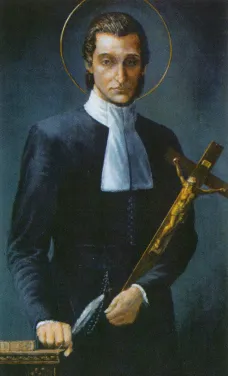
In 1842 an old manuscript was found buried in a trunk hidden in an attic in the town of St. Laurent-sur-Sèvre in France. The priest who discovered it was shocked to find it dated 1716 and signed by Louis de Montfort, the founder of his order, whose signature he later authenticated. More disturbing were the first lines he read as to why it had been hidden for 137 years: “I clearly foresee that raging brutes will come with fury to tear with their diabolical teeth this little writing and him whom the Holy Ghost has made use of to write it, or at least to envelop it in the silence of a coffer, in order that it may not appear.” The name of the treatise was True Devotion to Mary.
Saint Louis Marie Grignon de Montfort died in the very year that the book was hidden. He was forty-three years old. His untimely death was caused by an attempt to poison him in 1711 at La Rochelle. What did this little book contain? What made it so dangerous? Who wanted to destroy it?
Saint Louis Grignon de Montfort
Saint Louis de Montfort was born in 1673 in the town of Montfort-sur-Meu. His father, a native of Brittany, France, held prominent positions in the the town and parliament where he was born. He held these offices through his good services, or more possibly, his fearful temper, a trait that was inherited and valiantly harnessed by his young son. At an early age, Louis discerned a calling from God, and pursued a religious vocation. The clerical atmosphere in France, however, was slowly building towards a flashpoint that would erupt into revolution because of its worldliness and elitism. From the start of his religious life, Saint Louis, who had a simple, zealous desire to preach the message of salvation in order to save souls, was regarded as a fanatic. Misinterpretations and social manipulations of his spirituality by his confreres kept him constantly in trouble with his superiors, not only during his seminary years at Saint-Sulpice in Paris, but also in subsequent years. He took his priestly duties seriously among a clergy critically undernourished through spiritual ignorance.
“At an early age, Louis discerned a calling from God, and pursued a religious vocation.”
Jansenism
One of the main factors contributing to the ecclesiastical hostility that Saint Louis encountered came from the influence of Jansenism among the clergy. This insidious heresy was a slippery concoction of feigned piety that actually sapped the vitality of the sacraments by a pharisaical portrayal of holiness. Named after a Dutch priest, Cornelius Jansens, who was born in 1581 and later became Bishop of Ypres in Belgium, it became increasingly popular after his death. A brilliant student, first in his class in philosophy, Jansens was refused entrance to the Jesuits. Harboring a resentment for this, twice he gave testimony in Spanish court against them, resulting in the withdrawal of the Jesuit faculties to teach there. Despite his desire for revenge, he climbed the ecclesiastical ladder and became renowned for his teachings as the director of the episcopal college in Bayonne and Doctor of Theology at the University of Louvaine.
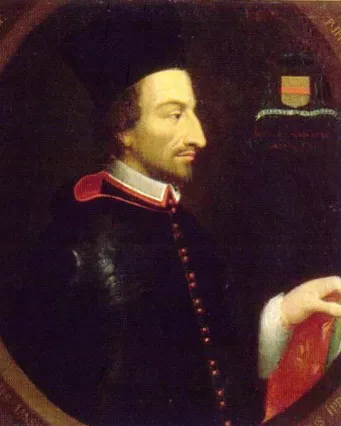
He was consecrated as Bishop of Ypres in 1636 and “governed with zeal,” dying there in an epidemic, with a reputation for piety. Before he died, however, he confided a manuscript to a chaplain requesting him to have it approved at the University of Louvaine and the Metropolitan Collegiate Church. The writings contained notes from his twelve years of studying Saint Augustine along with his views on grace and predestination. Although Jansens himself professed his loyalty to the Church on his death bed, his three-volume legacy contained “fundamental error—disregarding the supernatural order.” Jansenism, as it became known, was a “covert heresy that would not leave the Church sapping the spiritual life of its adherents by a strange salvation” from the Bread of Life, under the guise of being unworthy with a false humility.
This subtle but lethal heresy infected the French Church for a century, sometimes smoldering, but never entirely snuffed out. Between 1700 and 1716 a strong wave began to spread through the distribution of a pamphlet called “Case of Conscience” which was censored by Pope Clement XI. Its ramifications triggered government involvement through the seizure of a paper from the Oratorian priest named Father Pasquier Quesnel, a rabid Jansenist. Controversy over these tenets divided the hierarchy and infected the government. The common people “turned away from dogma in disgust” as a result, as one historian reported.
Jansenist condemned anything that reflected spontaneous love, childlike trust, spiritual liberty and divine grace
Saint Louis in his love for the Church and zeal for souls found himself surrounded by a lukewarm priesthood who with sacrilegious boldness, condemned as dangerous new devotions that would most revitalize and stir up the faith, such as love of the Sacred Heart of Jesus promoted by the Visitandine Saint Margaret Mary Alacoque. In short, Jansenist condemned anything that reflected spontaneous love, childlike trust, spiritual liberty and divine grace. This new heresy cultivated an air of formality devoid of charity. Among its pretensions to humble piety, the Jansenists encouraged their adherents to receive Holy communion a few times during one’s life. According to the Jansenist, “You will soon understand that you do more for yourself by not going to Holy Communion than by going” they taught.
The atmosphere among the Jansenist clergy was hostile to everything that Saint Louis held dear. His missions were welcomed with open arms by the laity but his success in parishes was actively undermined by the lukewarm hierarchy. Once Saint Louis succeeded in convincing his parish to turn away from pornographic literature, consigning it to a bonfire, as a gesture symbolic of their release from this addiction. As the pernicious books were tossed into the pile in the village square, Saint Louis addressed the parishioners in the church, strengthening their resolve. Unknown to him, however, one of his enemies hoisted a statue of a lady on top of the pyre hanging sausages from her ears to make the whole thing and the priest who thought of it, look ridiculous. The report of this, while hijacking the true intent, caused Montfort’s condemnation, thereby undoing his work among the people.
Saint Louis wandered from town to town giving missions and acting as a chaplain to the sick and destitute. Sometimes the priest in whose parish he held the missions would mount the pulpit to denounce the saint, discouraging people from attending. The faithful became more confused as they found themselves caught in the crossfire between the Jansenists and the true believers of the Faith.
The report of this, while hijacking the true intent, caused Montfort's condemnation, thereby undoing his work among the people.
Approval from Rome
Finally Saint Louis appealed in person to Rome. Traveling to the Eternal City on foot, he met the pope’s confessor, Father Joseph Tomasi, canonized in 1986 by Pope John Paul II. A “noted theologian” and accomplished scholar of the Sacred Liturgy, Tomasi, “saw what a weapon it would be against Jansenism and how this tall Breton would rouse the Faith in France….” Consequently, he arranged for Louis de Montfort to have an audience with Pope Clement XI. The pope sent Saint Louis back to France with the title “Apostolic Missioner.”
When he returned to his native France, Saint Louis “would tell the crowd of the truth that stands forever, and there was in him a joy and light which nothing could dim.” He was one with Rome! He traveled the countryside giving missions, helping build churches, and founding a hospital, but wherever he went he was harassed and at the mercy of the Jansenist hierarchy. One of Louis de Montfort’s evangelizing methods was to erect a large Calvary scene at the close of his missions as a lasting reminder to the attendees of the love of God and Christ’s sacrifice for our salvation. The largest and most impressive of these was completed at Pontchateau in 1710, just five years before he died. When it was first planned, news spread far and
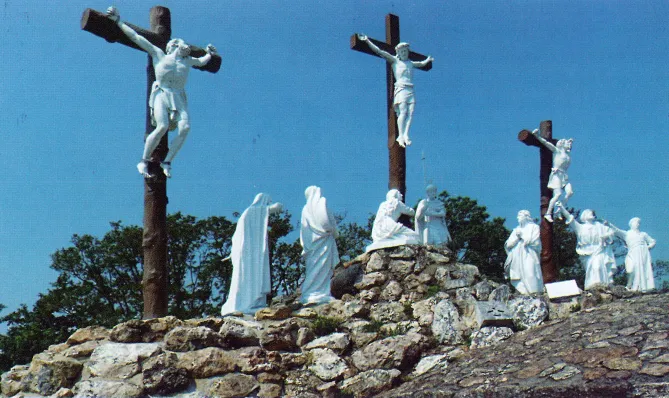
wide of this tremendous undertaking and pilgrims, both men and women, traveled from all over Europe to assist in building it. An estimated 300,000 cubic feet of soil was moved to create a sprawling seventy-foot-high mound for the center. The shrine was completed in fifteen months. A team of twenty-four oxen was required to bring the tree used for the main cross to top the shrine, which was one third of a mile in circumference. On the winding road leading to the top, fifty evergreens were planted representing the Hail Marys of the rosary, along with fifteen cypresses for the Our Fathers. The blessing of the shrine was to take place on September 14, the feast of the Exaltation of the True Cross. Government officials had been watching, however, and because France was at war with England, the authorities were suspicious of terrorist activities. Thirty thousand supporters came for the blessing, listening to sermons awaiting the arrival of the bishop the next day.
Without warning, however, the bishop announced the night before his planned arrival that he would not bless the shrine. Civil authorities had prevailed—after pressuring him with threats and alleging that the shrine was a terrorist stronghold. The bishop was too weak to defend one of his own priests. Several weeks later the militia arrived and ordered the shrine to be demolished. The immense mound, a labor of love, was leveled as Saint Louis and the demoralized faithful looked on in prayer. Tension increased and Montfort was silenced by the bishop and only given faculties to say Mass.