
Sister Katherine Maria, MICM
True Devotion to Mary: the Book
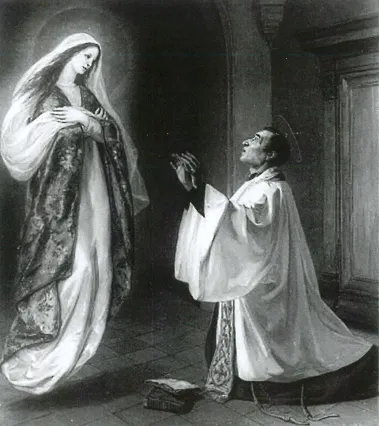
The little book called True Devotion to Mary perfected a devotion already found among the saints, bringing it to a more complete fulfillment. “I have taken up my pen,” explains Montfort, “to write down what for many years I have been teaching with success both publicly and privately in my missions.” Eleven years after its discovery, a decree from Rome pronounced Montfort’s writings to be exempt from all error which would be a bar to his canonization. Copious historical writings of saints and theologians support Montfort’s love and devotion to Our Lady. The startling difference is that he advances even further to a total commitment of slavery: “Having read nearly every book on devotion to the Blessed Virgin and talked to the most saintly and learned people of the day, I can now state with conviction that I have never known or heard of any devotion to Our Lady which is comparable to the one I am about to speak of.” His writings have attracted many followers in recent times. Pope Saint Pius X assured the faithful that, “I heartily recommend True Devotion to the Blessed Virgin, so admirably written by Blessed De Montfort, (now Saint), and to all who read it grant the Apostolic Benediction.” Pope Leo XIII granted a plenary indulgence to those who make the act of consecration as set forth in the book. Venerable Matt Talbot, an Irish laborer, traded his addiction to liquor on discovering these writings, and became a slave of Mary instead. “Totus Tuus,” the motto of Saint John Paul II is a direct quotation from Montfort’s book.
In the opening chapter referred to as “Preliminary Remarks,” Saint Louis de Montfort summarizes the purpose of his writing in the simple observation that “It was through the most holy Virgin Mary that Jesus came into the world, and it is also through her that He has to reign in the world.” Shortly after the manuscript was discovered, it was published in French and widely circulated. In 1846, it fell into the hands of a new English convert, Father Frederick William Faber who initially struggled with it, then fell in love with what he found. He translated it into English.
one of the twenty languages in which it was then available. Faber became one of the first and most ardent promoters of the book. In his own work, All for Jesus, Faber’s love and admiration for what Montfort wrote, shines through: “Persons often wish to know how much devotion they ought to have to our Blessed Lady, and where their love ought to stop. They are dissatisfied if they are told that they can never have enough devotion to her, that so far as degree is concerned there is no possibility of excess, and that there is no limit at which their love need stop. True as this is, it does not content them. They think it a sort of pious exaggeration, which is true in a sense, but no real answer to their question, or solution to their difficulty. They could hardly object, if it was said to them; you are to love Mary as much as Jesus loved her, you are to have as great a devotion to her as Jesus wishes you to have. You can have no scruple in praying to Jesus for this devotion according to His will.”
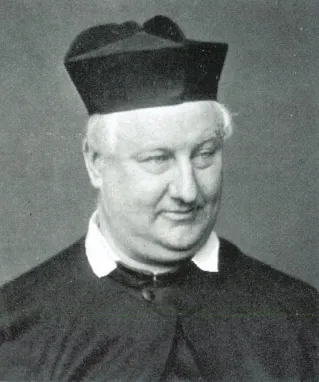
"you are to love Mary as much as Jesus loved her, you are to have as great a devotion to her as Jesus wishes you to have. You can have no scruple in praying to Jesus for this devotion according to His will."
Father Faber
Father Faber goes on to explain, “It is impossible to know Jesus, much more to love Him, if we have not a warm devotion to His ever blessed Mother. Nor can we conceive of any devotion to her more sure to move the Heart of Jesus to listen to our intercessions, that the offering to Him, those graces which He Himself bestowed upon her. Those mysteries in which she corresponded to these graces, and merited so unspeakably. She is so mixed up with the glory of God, that every act of homage to her is a plain act of love of God. She is herself so completely the choice interest of Jesus, that He has none on earth to compare with the defense and propagation of her honor! For, if His Sacred Heart be mercifully bent upon the salvation of souls He has chosen Mary as the refuge of sinners and the advocate of souls.”
“If all God’s works praise Him, and if when He looks upon the earth that He made, He was moved to bless it and to pronounce it very good, while the morning stars sang together, and the angels shouted for joy, how much more do His own works and gifts in Mary praise Him everlastingly, while she furnishes an unending theme for the songs of angels and of men! Oh, for the sake of Jesus we must learn to increase in our love of Mary. It must be a devotion growing in us like a grace, strengthening like a habit of virtue, waxing more and more fervent and tender until the hour when she shall come to help us to die well, and to pass safely through the risk of doom.”
Defending devotion to Mary, Father Faber says, “Do we think sufficiently of this—that devotion to our blessed Lady is not a thing which, like the possession of a book or a rosary, we have once for all, final and complete? It would be no less untrue to say that when we have received from God the grace of humility, we have simply to hold fast what we have got and never dream of getting more, than to say that devotion to Mary was an un-growing thing. I repeat, it must grow like a virtue, and strengthen like a habit, or it is worth nothing at all. Nay, it is worse than worth nothing, as a little thought will show you. Love of Mary is but another form, and a divinely appointed one, of the love of Jesus. Therefore, if love of Him must grow, so also must love of her. If a person were to say that you must not mingle prayer to Mary with prayer to Jesus, he would show that he had no true idea of this devotion, and that he was already on the brink of a very dangerous error.”
"Do we think sufficiently of this — that devotion to our blessed Lady is not a thing which, like the possession of a book or a rosary, we have once for all, final and complete?"
Father Faber
Father Frederick Faber goes on to warn those who are fearful of giving too much love to Our Lady lest their devotion to her compete with their devotion to her son, Jesus Christ, “…People sometimes thoughtlessly speak as if devotion to the Mother was a little trifle allowably cut off from devotion to the Son; that it was something surrendered by Jesus to Mary; that Jesus was one thing, and Mary was another, and that devotion to the two was to be divided, say a pound to him, and an ounce to her. If such persons really saw what they mean, which they do not, they would perceive that they were talking impiety.”
“Love of Mary is an intrinsic part of love of Jesus, and to imagine that the interests of the two can be opposed is to show that we do not understand Jesus, or the devotion due to Him. If devotion to Mary is not already, and in itself devotion to Jesus, then when we show devotion to her we are consciously subtracting something from Him, and so actually robbing God, which is sacrilege. When people tell us to keep within bounds, to moderate our devotion and not to go too far, or to do too much for Mary, they are not as they fancy securing to Jesus His rightful honor, but they are making the horrible confession that they themselves do take something from Jesus to give to Mary, though they are careful it should be not very much. How dreadful this sounds when put in plain words!
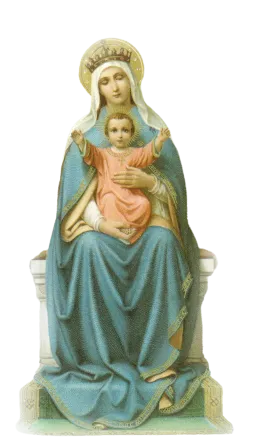
“Devotion to Mary can be wrong in kind; it can never err in degree. If love of Mary be not love of Jesus, if devotion to Mary be not one of His own appointed devotions to Himself, yes, and the chief one too, then my theology as well as my love tells me I can have no room for Mary at all; for my heart cannot adequately hold Jesus as it is. Dearest Mother, how little I should know of you, if I could think of you so dishonorably! And what a poor, low notion should I have of God Himself! I might as well think grace kept me from God, or sacraments enabled me to do without Jesus, as imagine that you did anything else but gloriously magnify His Love for me, and wonderfully intensify my love of Him!”
Saint Louis De Montfort closes his “Preliminary Remarks” by explaining, “It is with particular joy that my heart had dictated what I have just written, in order to show that the Holy Mary has been up to this time insufficiently known and that this is one of the reasons that Jesus Christ is not known as He aught to be. If then, as is certain, the knowledge and the kingdom of Jesus Christ are to come into the world, they will be a necessary consequence of the knowledge and the kingdom of the most holy Virgin Mary, who brought Him in to the world for the first time, and will make His second advent full of splendor.”