
Sister Katherine Maria, MICM
True Devotion to Mary:
The Writing of the Book
Despite this triumph of the Jansenists, Saint Louis continued his apostolic labors. His colorful personality contrasting with the drab, indifferent hierarchy and made him a puzzle to all… “Is he an apostle or an angel?” they would often ask themselves. His imposing and fearless confidence seemed incapable of discouragement. Detached from his own interests, his motivation was pure love of Christ and His Mother. Louis’s holiness presented an affront to sinners, who either converted through his efforts or hated him like demons. In 1700, five men plotted to “blow his brains out,” but Saint Louis discovered the plot and detoured around the planned ambush. “If martyrs had been as timid as we are,” he would say, “they would not have their palms.”
At La Rochelle in the Vendee region of Northwest France, Saint Louis wandered at last into a welcoming diocese in 1711. There his evangelizing efforts were so effective that he converted two of the city’s most prominent and vocal Protestants, one of whom entered a convent of Poor Clares. This aroused the anger of the Calvinists, whose rage would not be quieted. Frequently the priest was greeted with a hail of stones and, more frequently, with cries of “Kill Montfort!” One night his enemies poisoned his broth at dinner. Louis sensed something was wrong so he did not consume the whole bowl. Nevertheless, the amount consumed was sufficient to undermine his health and eventually kill him. Saint Louis knew his time in this life was limited, and so he outlined his spirituality in the little fateful book that he had hidden. It contained the secrets that gave him the strength to remain joyful under the adverse circumstances of his short life. During his untold sufferings, he had discovered a method of prayer and devotion that more than sustained him; in fact, a devotion that invigorated him with more zeal. It was also an apocalyptical masterpiece of Marian devotion.
"If martyrs had been as timid as we are,they would not have their palms. "
Saint Louis Grignon de Montfort
The "Brutes" that Sought to Destroy the Book
The years following Grignon’s death, although peaceful, were leading up to a social tumult that would reverberate throughout the world known as the “French Revolution.” The Jansenist heresy had left its scars on the clergy. For years the priestly formation suffered from it. The emerging French clergy was divided; some priests and bishops were truly religious, aspiring to become saints and others were immersed in worldly pursuits and pleasures. The monarchy, although good, was insulated and aloof from its suffering subjects. This attitude created a chasm that was to have a devastating effect on the country. After the death of Louis XIV in 1716, there prevailed what one historian describes as, “an aggressive movement against every authority, spiritual, as well as temporal along with unfettered criticism of the government prevailed.” Disbelief and libertine philosophy reigned at court, and a cry for equality unsettled the disgruntled, desperate citizens.
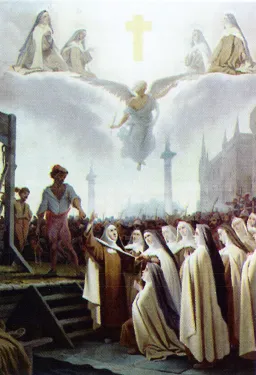
The majority of uncatechised, ill educated peasants fell prey to revolutionary agitators who used them in an effort to destroy the Church and to overthrow the government. Through atheistic propaganda the revolutionaries spread their manifesto to the public as a democratic liberator for freedom. Instead, it enslaved its adherents in a frenzy of emotional, mindless violence. Appealing slogans offered hope to the abused and impoverished, who rallied in the streets and stormed buildings. Religious institutions were also stormed, closed, or confiscated, and countless priests and nuns were imprisoned. In the eyes of the Revolution there were no longer good priests and bad priests; every priest was considered bad. With or without a trial priests and religious were executed by the hundreds. Chaos, a tool of Satan, turned civilized society into a place of madness. A blood lust brought the guillotine onto the scene and, with insatiable cruelty, enemies of the revolution were decapitated, sometimes to the accompaniment of an orchestra.
Without a doubt, these revolutionaries were the “brutes” who would have torn to shreds the writings of this saint, depriving this generation of its riches, had Montfort not hidden it in the chest.